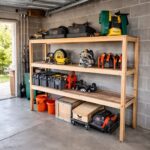

The 13 ideas below run from a cardboard box that lasts a season to a backlit wall display wired to a switch, so the deciding factor is how permanent your storage needs to be and whether you are hiding shoes or framing them.
I would start by watching where shoes actually land for a week; the back door pile and the closet cluster need different setups, and a basket test run tells you the real count before you buy a single board.
1. DIY Skateboard Shelf

Skateboard decks drilled through their truck holes and threaded onto metal rods make a shelf that reads as gear from the sport, not craft-project cute.
The rods need lock nuts top and bottom; without them the decks tilt and the whole rack walks itself out of square.
I would check that the deck graphics face the same direction, since the grip-tape side is the one that holds shoes from sliding.
4 pairs per tier is the practical limit; beyond that the rods bow. This one suits a garage entry or a kid’s room where the aesthetic is already halfway there.

Quantity :2 flexible skateboard hangers,2 Stainless steel R rings and 2 screws and 2 expansion plugs. No Board included.

【Space-Saving & Multi-Scenario Use】This skateboard rack floor stand features a vertical design for efficient space use, fitting small areas and corners easily. Compared to horizontal skateboard storage, it saves up to 80% floor space, ideal for small homes, apartments, or skate shops. Its rust-proof coating ensures versatility indoors and out—perfect as a reliable skateboard rack for garage use.

Reinforced thermoplastic and comes with stainless steel screws and bolts
2. DIY Shoe Ladder Shelf

A leaning ladder shelf needs no wall mount, which matters in a rental.
The rungs sit at an angle, so shoes rest heel-to-toe rather than flat; that cuts capacity by about a third compared to a horizontal shelf of the same width.
A plant on the top rung is the right call; the upper levels are awkward for daily-use shoes anyway.
Check the floor where the feet land; on carpet the ladder creeps, on tile it skids. A rubber pad or felt under each foot fixes both.

Contemporary 5 Tier Design: Leaning wall bookcase ladder features 5 tiers, each shelf has 3 sides with 20-inch width and raised lip 2-inch height

ATTRACTIVE DESIGN: The Kiera Grace Providence Hadfield 5-Tier Ladder Shelf is a modern leaning storage shelf that adds an elegant touch to any space. The sleek finish complements any decor, making it a great fit for your living room at home or the office.

5-TIER LEANING LADDER SHELF – This 50-inch tall wood ladder shelf offers vertical storage with a minimal footprint. Perfect for displaying books, plants, décor, or essentials in the living room, bedroom, bathroom, or home office.
3. Industrial Style Shoe Rack

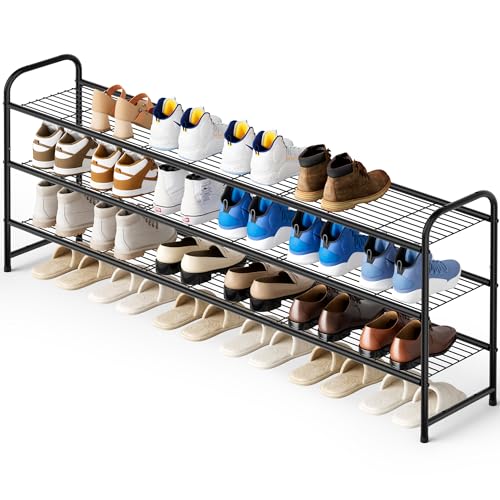
The welded frame and slanted wire shelves here are factory-made, but the look is easy enough to build from black pipe and wire closet shelving cut to width.
The wooden top is the detail that warms it up; without that slab it reads as garage storage.
The slant on the shelves is shallow, maybe 15 degrees; steeper and the shoes slide, shallower and you lose the forward visibility that makes this style work.

Capacious and thoughtful Shoe Rack:The front door shoe rack sizes 27.8"L x 10.8"W x 65.4"H . This tall shoe rack boasts 9 storage shelves and 1 top shelf for 30-40 pairs of shoes, making it competent to store shoes of whole family. The metal shoe organizer is equipped with 3 iron sheets, so that the high heels can be smoothly placed on them. If you have tall shoes, you can remove a shelf

Maximize Space: With 10 tiers of ample storage, this large shoe rack keeps your footwear collection in perfect order. Say goodbye to cluttered entryways, closets, garages, or bedrooms, and welcome a tidy living space!

This thoughtfully designed metal wire shoe rack showcases a free-standing frame and holds up to 9 pairs of shoes
4. DIY Painted Shoe Bench

Painted benches are where I would put my time if I had a Saturday and a brush I already liked.
The shoe cubby underneath is straightforward box construction; the surface is where the project lives or dies. The botanical and abstract mix looks hand-done, not stenciled, and that irregularity is what keeps it from reading as furniture-store generic.
I would prime with a shellac-based primer so the oils in the wood do not bleed through the light colors, then seal with water-based polyurethane so the painted surface survives scuffing. 2 coats minimum; the shoes will kick it.

【Unique Design】With soft cushion, the shoe bench as both small shoe rack and entryway bench. Handles on both sides make it easy to move. Adjustable shelf with 3 heights, so you can place heels, sneakers, tall boots, etc. The shoe bench features pull-out drawer for secure storage of gloves, wallets, and keys. These thoughtful designs make it an excellent shoe organizer for entryway

【Functional Shoe Bench】Comes with 9 cubbies to store 7-9 pairs of shoes; a perfect storage solution to keep your room neat and uncluttered; matches perfectly with your furniture; spacious storage is ideal for entry porch, front door, living room, bedroom, garage, closet and more

[Extra Large Storage Space] The size of the shoe stool is 11.8 x 59 x 18.9 inches. The cushioned shoe stool has 18 compartments, with each cell measuring 11 x 9.44 inches. There is no need to stack shoes or place them on the side
5. DIY Cardboard Shoe Rack

Cardboard cubbies work for a season or two, which is sometimes exactly the right commitment.
I would trace the footprint of my largest shoes and add half an inch all around before cutting; the cubbies look tight, and boots or men’s 12s would not slide in clean.
Tops planted with succulents, like here, need a drip tray; wet cardboard is done.

20 Shoe Cubby - 20 durable reinforced cubbies create 20 separate shoe storage cubbies for multiple uses, hold up to 20 pairs of shoes or accessories.

4 x 4 Cube Cubby: sturdy metal frame with reinforced fabric cube cubby. Hold 16 pair shoes

ORGANIZED SHOE STORAGE: Keep your shoes and accessories neatly arranged with 12 spacious cubbies and a large bottom drawer. Ideal for storing everything from sneakers to hats, this shoe rack provides a clutter-free solution for your bedroom or closet, helping you make the most of your small spaces.
6. DIY Lazy Susan Shoe Case

A rotating tower eats vertical space instead of spreading across a wall, which is the trade I would make in a narrow entry or a closet corner.
The bearing at the base carries all the weight; a lazy Susan hardware kit rated for heavy loads is the part to buy right, since a cheap turntable binds and chatters once you load it.
The circular shelves have a lip around the edge, and that is not decorative: without it, a pair of heels launches itself on the first spin.
I would keep the diameter modest so the reach to the back is still comfortable.

【Multifunctional Wall Rack】A snowboard rack wall mount designed for all types of skateboards, including longboards, decks, skis, snowboards, and kiteboards, to keep your equipment tidy and organized!

【LARGE CAPACITY & SPACE-SAVING】The wall-mounted skateboard rack holds up to 5 skateboards, offering ample storage while saving space. It includes a top shelf and 6 bottom hooks for storing additional skateboard gear like helmets, pads, backpacks, shoes, and gloves. This makes it a stylish addition to living spaces, bedrooms, and garages, keeping everything organized and tidy.

【360°Rotation Adjustable at Any Angle】:This skateboard deck wall mount uses a unique design that can be easily rotate 360 degrees if desired.When you want to change the direction of the skateboard, you don't need any auxiliary tools, just use your fingers to adjust the screw cap on the back of the deck mount.If you are a collector or player of skateboard or deck,this is the perfect product for you,especially for collector display and skateboard display.
7. DIY Shoe Cubby

A hall tree with cubbies underneath turns a wall into a drop zone for coats, bags, and shoes in one piece.
The bench height matters more than I expected; too low and sitting to pull on boots is awkward, too high and the cubby clearance shrinks.
I would check that the cubby depth matches my longest shoe plus an inch for fingers; a boot wedged too tight is daily frustration.
The open front is what makes this fast to use, but it also means dust settles; a spot near the door, not the bedroom, keeps the grit where it belongs.

5-Tier Tall Bookshelf: It combines 5 open shelves and a removable non-woven drawer. It is suitable for placing books, plants, albums or necessities, keeping the space tidy and storing more items. Each shelf is capable of holding up to 33 lb

Adaptive Lighting for All Day: This ladder shelf features a versatile light strip with three adjustable colors, offering both functionality and ambiance. Easily control the colors and brightness to provide lighting for reading, working, or relaxing

Modern Form, Lasting Appeal: Clean lines and balanced simplicity define this BARNET Collection ladder shelf, combining a steel frame with rustic panels to create visual depth and pair easily with matching storage units for a cohesive, modern interior
8. DIY Tension Rod Shoe Rack

Tension rods wedged inside a closet alcove hold heels by their arches in rows that read as color blocks.
The rods need pressure against solid side walls; drywall alone will push through over time, so I would find the framing or add a plywood backer.
The visible setup sorts by color, which works because every shoe faces the same direction; mixed directions break the grid and waste rod space.
Boots still line the floor, so this is not the full solution, just the upper half. I would check rod diameter; anything too thin and the span sags under leather weight.

4-Tier Shoe Rack Organizer: Store 20-25 pairs of shoes effortlessly on this wide shoe stand (33"W x 11"D x 30.5"H). Perfect for adult shoes, kid's shoes, sneakers, casual shoes, boots, etc. Additional bottom storage for daily flats and slippers

Customizable - You can split a tall, narrow shoe rack into multiple smaller shoe racks. Upon splitting, the smaller shoe racks are works independently, even in different rooms. Please refer to the instruction manual in the package.
9. Wall-Mounted Wooden Shoe Rack

A slim rack screwed to closet wall studs stores shoes toe-in, heel-out, taking depth instead of width from the floor.
The slots are shallow front to back; that is enough for sneakers but not for boots, which this version simply excludes.
I would mount it at hand height, not floor level, since bending to the baseboard defeats the purpose of vertical storage.
The wood face is what you see when the closet door opens, so I would stain or paint it to match the closet interior rather than leaving it raw.
Even if you have a small entryway that can’t fit a shoe rack, you can store them in style in other places in your home—and best of all, you can make those storage solutions yourself.

Multifunctional Shoe Cubby Bench: Are your shoes are piled up all over your entryway? This entryway cabinet will be the perfect solution for you. This storage bench with 12 compartments is able to store the daily shoes of your whole family. The hooks in 2 rows hold jackets and accessories

Multifunctional Shoe Cubby Bench: Are your shoes are piled up all over your entryway? This entryway cabinet will be the perfect solution for you. This storage bench with 12 compartments is able to store the daily shoes of your whole family. The hooks in 2 rows hold jackets and accessories

【Save Space】The 12-cube shoe rack with a unique vertical storage design, small footprint, is the entrance porch, front door, living room, bedroom, garage closet and other small space storage choice. Help you make the most of your space and make your home more organized.
10. Tall Multi-Tier Wooden Shoe Tower
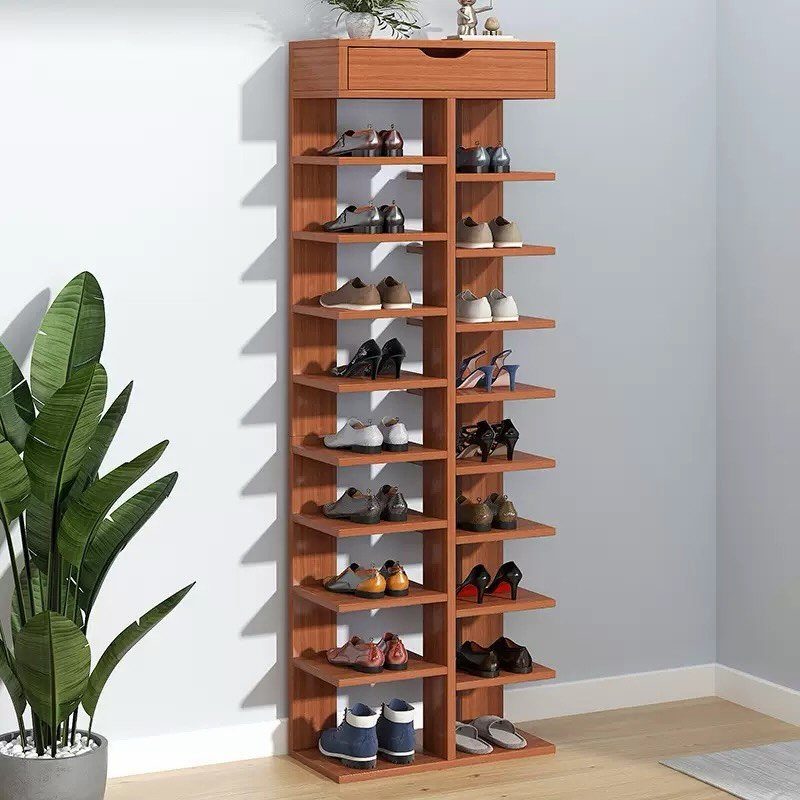
A freestanding tower with a drawer on top uses height to keep more pairs in a footprint smaller than a wastebasket.
The top drawer is the detail that elevates it from pure storage; keys, a wallet, or a dog leash live there so the tower earns its floor space beyond shoes.
I would check the base for levelers; on any floor but dead flat, a tall narrow piece rocks when you pull the drawer.
The tiers are fixed, so this suits a household with one shoe profile; mixed heights, and the loafers swim while the ankle boots do not fit.

20 Shoe Cubby - 20 durable reinforced shoe cubbies create 20 separate shoe storage cubbies for multiple uses, hold up to 20 pairs of shoes or accessories

Save Space: The 16-cube shoe rack with a unique vertical storage design, small footprint, is the entrance porch, front door, living room, bedroom, garage closet and other small space storage choice. Help you make the most of your space and make your home more organized

Dimensions: 14" x 33" x 24"
11. Illuminated Wall Display Shelves

Backlit floating shelves turn a sneaker collection into wall art, which is a different goal than hiding shoes away.
The lighting is the project here; LED strips routed behind a lip on each shelf cast upward and wash the shoe without glare.
I would wire to a switch, not a plug, since reaching behind furniture to kill the glow gets old.
12. PVC Pipe and Wood Shoe Rack

PVC pipe cut to length and joined with corner fittings makes a frame that holds wooden shelves in a grid that looks clean and wipes down easy.
The pipe diameter sets the shelf span; thin pipe starts to bow across a wide gap, so I would keep boards short or step up to thicker stock.
The white pipe against dark wood is the contrast that makes this read as design rather than hardware-store parts; gray electrical conduit would not hit the same note.
I would glue the fittings for rigidity but leave the shelves loose; seasonal swap to taller gaps is easier that way.
13. Wire Mesh Cube Shoe Organizer

Wire mesh cube organizers snap together in any grid you need, which is the point: a 2×2 fits a closet corner, a 3×3 fills a wall.
The cubes hold sneakers toe-first with stacked shoeboxes above, using height that would otherwise go empty. I would check cube depth against my longest shoe; men’s 11s or high-tops need the deeper cubes, not the shallow ones.
The open wire shows dust, so this belongs near a door where grit is expected, not in a bedroom. White coating chips where the clips bite; black hides that wear better if the room can take it.
Advice for Organizing Shoes
Shoes multiply fastest where they land, not where they belong. I would walk my own entry points with a notebook before building anything; the pile by the back door and the cluster in the bedroom closet usually need different physics.
A temporary basket or cardboard box placed there for a stretch tells me the real count and the real traffic pattern; the spot I assumed was the problem often is not.
Rental restrictions mean I lean toward tension rods and freestanding pieces rather than wall mounts, though a stud finder and a few screws are worth the deposit risk if the storage actually gets used.
Boots, sneakers, flats, and heels each demand their own height and depth; any rack built for one type ends up half wasted and half bursting.
Materials for DIY Shoe Racks
Wood, PVC pipe, crates, and repurposed items like skateboards or paint cans cover most of what I would reach for.
Paint cans mounted as cubbies read farmhouse only if the surface is handled; raw metal rings industrial, which is a different room.
Wooden crates stack to depth and width you choose, and the gaps between slats ventilate better than solid sides. PVC wipes down with a damp cloth, which matters near a door tracked with mud and salt.
I would spend the extra dollar on furniture-grade pipe; the thin-wall stuff at the hardware store flexes under shelf weight and the fittings crack if you torque them tight.
Space-saving Tips
Vertical space is the first place I look when floor area is scarce. Under-bed storage is dead space already paid for; shallow bins on casters pull out without lifting the mattress.
In a shared closet, the upper half belongs to whoever can reach it; tension rods or wall-mounted racks at hand height keep the peace. I would measure my tallest boot and my lowest shelf before cutting anything to length.
Frequently Asked Questions
What material is best for a shoe rack?
Wood, PVC pipe, and metal are the materials I would reach for, each for different reasons. I would spend the extra dollar on furniture-grade PVC rather than thin-wall hardware-store stock, which flexes and cracks where fittings bite.
What are some good shoe storage options for a narrow space?
A rotating tower eats vertical space instead of spreading across a wall, which is the trade I would make in a narrow entry or closet corner.
Under-bed bins on casters pull out without lifting the mattress, using dead space already paid for.