I’ve stubbed my toe on enough lamp bases to know placement matters. I tuck slim arc lamps behind my low-slung sectional, which bounces light off the ceiling and makes the whole room feel bigger without moving walls. For reading, I park one slightly behind my shoulder, angled over the page so I’m not squinting at shadows. Corners are where my tall uplighter lives, washing walls with warm glow instead of that harsh overhead interrogation vibe. I map my dark spots first by walking the room at 9 a.m., noon, and dusk, because sunlight shifts everything. One lamp per 100 square feet keeps it simple, though my cozy 350-square-foot space needed three to really chase the gloom. The right spot turns a lamp from obstacle into atmosphere, and your shins and eyeballs will benefit once you see where the light actually lands.
Find the Dark Spots in Your Living Room

Where do I even begin when my living room feels like a cave at 4 p.m.? I start hunting dark spots, that’s where. I grab my phone, I walk every inch, and I get real honest about where shadows win.
I check behind my sofa, a total light graveyard. I peek beside my chunky armchair, that spot where I actually want to read. I note entryways that feel like walking into a closet. I visit at 9 a.m., noon, and that dreaded late afternoon, because natural light shifts and I’m not guessing where I need backup.
I mark zones where I’m squinting at my Switch, where I abandon books. I even wave a flashlight around like a detective. If it’s still dim with ceiling lights blazing, I’ve found my target. Smart lighting placement starts with this detective work, and your future floor lamp placement depends on it.
How Much Light Does Your Living Room Need?

How much light do I actually need in here, and why did I spend three years squinting like a confused mole before figuring it out. Turns out, there’s math for this, and it’s actually freeing.
My lighting plan started with lumens, that weird word measuring brightness. Here’s the breakdown that saved me:
| Lighting Type | Lumens Needed |
|---|---|
| Ambient lighting | 20–30 per sq ft |
| Task lighting | 50–75 per sq ft |
| My 200 sq ft living room | 4,000–6,000 total |
I layer floor lamps with overhead fixtures, boosting dark corners where I actually live, near my worn velvet chair and by the puzzle table. No more shadows swallowing my coffee. Measure your space and match lumens to activities. Your room will function properly with adequate illumination.
Put Floor Lamps Beside Sofas and Reading Chairs
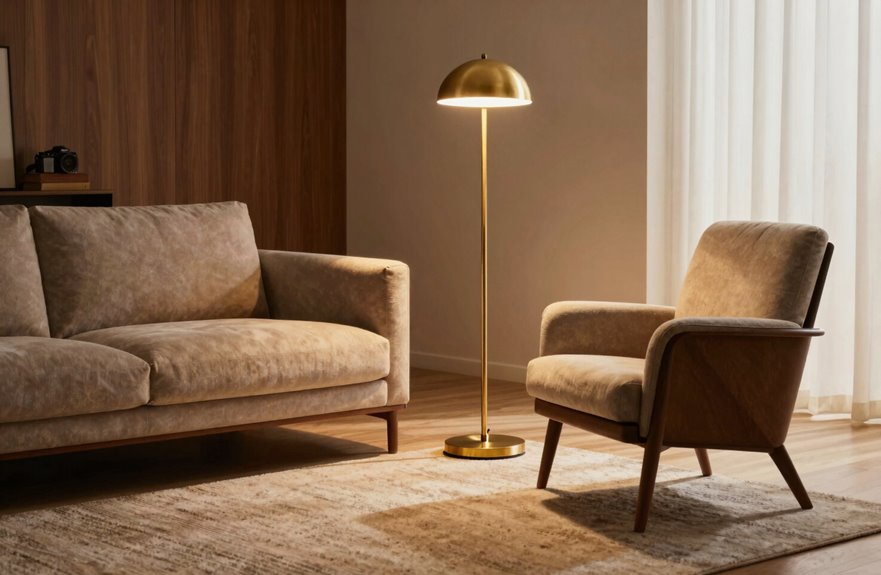
I’ve learned the hard way that cramming a lamp directly in front of my reading chair turns my cozy nook into an obstacle course. Instead, I tuck mine slightly behind or to the side, angling that swiveling head downward so my book pages glow without that harsh glare that makes me feel like I’m staring into a low-budget interrogation scene. It’s all about matching the lamp to your actual seating setup. Position the shade at elbow height, choose a warm bulb, and consider a translucent one if you want soft ambient lighting while you’re snacking and scrolling through your phone at midnight.
Optimal Reading Light Position
Beside your favorite reading chair is exactly where a floor lamp belongs, after years of squinting at pages under harsh overhead lights.
Getting your floor lamp placement right transforms how you actually live in your space. Here’s what works for perfect reading light:
- Position that lamp slightly behind your shoulder, not directly ahead, so you’re not staring into the bulb like a confused moth.
- Grab an adjustable-arm model. You’ll benefit from angling task lighting exactly where your book sits.
- Keep it close enough to reach without stretching, far enough that you’re not kicking it during conversations.
- Aim that reading light over your shoulder, eliminating shadows that make words disappear.
- Match your reading position to the lamp’s sweet spot, where contrast pops and your eyes relax.
Proper lamp positioning reduces eye strain and improves reading comfort.
Avoiding Glare Issues
Ever sat down to binge your favorite show only to catch a blinding reflection of your lamp in the TV screen. I’ve been there, squinting like I’m solving a mystery instead of relaxing.
What I’ve learned about glare reduction comes down to light direction. I tuck my floor lamp slightly behind my shoulder, never dead-on, so the glow arcs over me like a cozy canopy. An adjustable lamp is my top tool. I swivel the head away from glossy coffee tables and toward my book. A diffuse shade softens everything, eliminating harsh spots dancing across my laptop.
I test angles at different hours, because sunlight shifts everything. Your eyes will benefit from this adjustment, and your viewing experience will improve noticeably.
Complementing Seating Layout
Where do I actually park this lamp so it works with my furniture instead of fighting it. Smart floor lamp placement means positioning your light to complement your seating layout rather than placing it arbitrarily.
Here’s what works in my space:
- Tuck the lamp beside your sofa’s armrest, angled slightly behind you. This positions task lighting to illuminate your book without creating glare for others watching nearby.
- Position it to the side of your reading chair, never dead-center, so light spills across your lap with even coverage.
- Align with the armrest, not the cushion front, keeping that pathway clear for movement around your seating area.
- Grab adjustable-arm styles, because we’re switching from novels to phones to board games constantly.
- Pick translucent shades or dimmers, letting you flip from focused task lighting to ambient lighting when guests arrive.
This approach acknowledges how we actually live: using our spaces for multiple purposes that require flexible lighting solutions.
Light up Empty Corners With Floor Lamps

I’ve got to tell you about my favorite lighting trick, the one that saved my own living room from feeling like a cave. Corner lamps are game-changers for empty corners that swallow light whole.
Tall floor lamps in corners shoot light upward, bouncing it off ceilings for gorgeous ambient lighting that doesn’t crowd your seating. Tripod lamps sporting big drum shades maximize light spread while anchoring the space visually. Place them slightly behind adjacent seating, and you’ll eliminate glare.
Wide shades or multiple bulbs are essential. They disperse light evenly across walls, making rooms feel bigger, brighter, and more alive. Tuck yours near plants or art, letting decor reflect that glow and eliminate shadowed patches. Your cozy corner will benefit from this approach.
Brighten the Space Behind Your Sectional
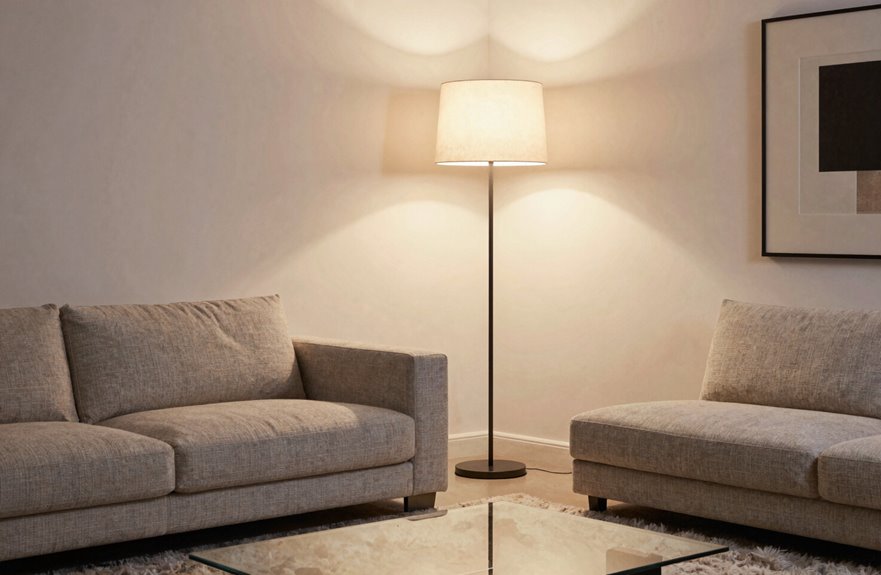
I love tucking a tall floor lamp behind my sectional. It throws a gorgeous, balanced ambient glow up toward the ceiling, and suddenly the whole room feels bigger and softer, less cave-like. It’s not just about brightness; that single placement trick actually defines your seating zone, like drawing an invisible circle that says “cozy conversation happens here” without blocking your path to the kitchen. I’ve tripped over enough furniture to know that matters. Go slim with the design, such as arc styles or pencil-thin poles, because nobody wants a bulky base cramping their style when they’re already squeezing past the couch with a snack plate.
Balanced Ambient Glow
Why does the space behind your sectional always feel like a black hole swallowing all your cozy vibes? That shadowy void kills the mood faster than my aunt’s questionable casserole.
Smart floor lamp placement fixes this instantly. Position a tall lamp behind your sectional’s center, and suddenly everyone’s included in the warm glow. No more back-row guests squinting in darkness.
What transforms your living room lighting:
- Upward-facing shades bouncing soft light off the ceiling, like a gentle hug from above
- Slim arc designs that slide into tight corners without blocking traffic
- Dimmable smart bulbs shifting from bright chatter to movie-night cozy
- Strategic distance from screens for glare prevention that actually works
- Even wall-washing that makes your whole space feel bigger, warmer, more inviting
Ambient lighting isn’t just functional. It’s an invitation to gather and feel welcomed in your space.
Space Definition Benefits
That warm, even glow we just talked about improves significantly when you place a floor lamp behind sectional seating. The dead zone behind your couch, where shadows used to pool like uninvited guests, comes alive with soft, reflected light.
This technique works because the floor lamp behind sectional placement bounces ambient lighting off your ceiling, stretching the walls outward without harsh glare hitting anyone’s eyes. You gain the visual effect of additional square footage without the mortgage.
The vertical balance this creates is notable. Your low-slung sectional finally feels grounded, not squatty, because that tall fixture draws the eye upward.
Pair it with a table lamp nearby for layered lighting, and you’ve got depth, dimension, and a space that functions well. The combination of multiple light sources at different heights creates visual interest and makes the room feel larger and more intentional.
Slim Design Choices
How do you squeeze light into that awkward gap behind your sectional without turning your living room into an obstacle course? This slim design approach works smarter, not harder.
Here’s my tried-and-true formula for perfect living room placement:
- A narrow floor lamp, roughly 120–150 cm tall, tucked behind the sectional’s back edge
- Translucent or upward-facing shade that kisses the wall with soft, diffused glow
- Tripod or arc silhouette with minimal footprint and maximum style
- Dimmable LED bulb for mood shifts from cozy Netflix nights to bright reading sessions
- Slightly off-center positioning, behind and to the side, banishing shadows effectively
This ambient lighting trick creates a gentle boundary without blocking traffic flow. Your sectional’s backside will benefit from this enhancement.
Add Floor Lamps Near Windows and Fireplaces
Where exactly should you park that gorgeous floor lamp so it actually earns its keep? The sweet spots are near your windows and fireplaces.
Park that gorgeous floor lamp where it earns its keep: near windows and fireplaces.
Floor lamps beside windows deliver practical benefits. A translucent shade softens daylight without throwing glare back at you. Slim arc designs tuck behind seating, bouncing light up walls without blocking traffic. With a corner window, a tall lamp with an upward shade turns your ceiling into a reflector, amplifying light throughout the room.
For fireplaces, position lamps to enhance the ambiance. Warm bulbs with a dimmer balance the flickering fire with ambient fill light. This eliminates harsh shadows and creates an inviting atmosphere.
Lighting placement requires intentional decisions about where you position fixtures. Windows and fireplaces are the focal points where people naturally gather, making them ideal locations for thoughtful lamp placement.
How Many Floor Lamps Does Your Living Room Need?
I learned the hard way that my tiny 150-square-foot living room didn’t need three lamps. It looked like a furniture store exploded. Now I follow the rough rule of one floor lamp per 100 square feet, though I’ll add extra lamps if dark corners interfere with my reading nook. Balancing layered lighting prevents both shadow squinting and the harsh effect of interrogation-style brightness.
Room Size Considerations
Why does room size matter so much when you’re figuring out lamp placement? Cramming too many lamps into a tiny first apartment creates an obstacle course.
Your room’s size directly shapes how much illumination you need and where each lamp belongs. Here’s what works:
- One lamp per 100 square feet keeps things balanced
- A 350-square-foot living room needs three lamps to chase away those gloomy corners
- Compact spaces under 150 square feet work well with one tall uplighter without the clutter
- Bigger rooms with multiple seating zones demand four to six lamps for even glow
- Always map your room layout first. Nobody wants to trip over cords during movie night.
Consider traffic flow when finalizing placement, ensuring switches stay within easy reach.
Layered Lighting Balance
How many floor lamps does your living room actually need? Through too many late-night Amazon purchases, I’ve found that one per 100 square feet achieves the sweet spot for layered lighting without turning your space into a stadium.
I used to think one corner lamp was sufficient. It’s not. For real balance, pair ambient ceiling glow with floor lamps tucked behind your sofa, angled toward seating areas where you actually spend time. Adjustable heads transform reading nooks into functional spaces.
In my open-concept living area, mixing heights creates depth that flat overhead lighting cannot achieve. A 120 cm lamp beside the chair paired with a 190 cm lamp towering behind the credenza adds dimension. Space them to eliminate dark corners and never block pathways, since stubbed toes diminish the lighting’s effectiveness.
Your layered lighting should feel like a warm hug, not an interrogation.
Seating Area Support
Where exactly are you supposed to curl up with that novel you’ve been meant to finish? Every seating area deserves its own floor lamp, with no exceptions.
- One floor lamp per 100 square feet keeps ambient lighting cozy, not clinical
- Position your reading light 120–130 cm high, so it sails right over your chair back
- Tuck lamps a quarter-meter behind sofas to eliminate shadows
- Adjustable arms let you pivot away from the TV, because nobody wants glare during movie night
- Multiple seating zones require additional lamps. Dark pockets between furniture create underlit areas that should be avoided
One instance involved three friends on one sofa with a single lamp; they were practically sharing a spotlight like amateur detectives. This arrangement didn’t work well and shouldn’t be repeated.
Choose Floor Lamp Height and Style by Room Size
What happens when you bring home a gorgeous 190-centimeter arc lamp and realize it towers over your tiny studio like a streetlight in a dollhouse? I’ve been there, friend, and it’s not ideal.
Floor lamp height significantly affects your space’s functionality and aesthetics. For compact spaces, 120-130 cm lamps work best, providing sufficient ambient light without overwhelming the room. In larger living rooms, a 190 cm lamp effectively fills corners with light and creates visual balance.
Room size dictates everything. A dainty base beside a chunky sectional creates visual discord; a weightier base establishes better proportional scale. For reading comfort, position the shade 5-10 inches above your sofa top to reduce glare and eye strain during extended reading.
Fix Glare and Shadow Problems With Small Moves
Why does my living room feel like an interrogation room at 7 PM? Squinting at my laptop while a lamp blasts straight into my retinas is uncomfortable. Here’s how to fix glare and shadows with smart lighting placement.
Glare reduction strategies:
Glare reduction strategies: Tuck floor lamps behind your sofa, angle light over your shoulder, and swap in translucent shades for soft, shadow-free illumination.
- Tuck your floor lamp placement slightly behind the sofa, angling light over your shoulder for cozy reading without screen reflection
- Grab adjustable-arm lamps to swivel light exactly where you need it, eliminating harsh shadows on your book
- Position lamps near corners to bounce soft illumination off walls, removing blinding hotspots
- Swap in translucent shades that diffuse light beautifully, creating a warm glow throughout your room
- Match shade height to eye level when seated, balancing ambient task lighting perfectly
These small adjustments make a significant difference in comfort and usability of your space.
Match Your Floor Lamp to Your Living Room’s Look
How on earth did I end up with a sleek chrome arc lamp glaring at my grandma’s floral armchair like it’s judging her life choices? I’ve learned the hard way that floor lamp design and living room style need to actually talk to each other, not throw shade; well, except literally.
Now I match my pieces like I’m curating a vibe, not a garage sale. I mix industrial bases with boho spaces, but I watch proportions carefully. No tiny shade should drown beside a chunky sectional. For movie nights, I grab shade translucency that’s soft and glowy. For my reading nook, I choose opaque and focused lighting.
Adjustable lighting saved my neck, literally. Swivel heads work for gaming, and dimmers set the mood for date night. LED smart bulbs keep my electric bill under control. Your eclectic mashup can work beautifully when it’s intentional.
Where Floor Lamps Work Better Than Overhead Lights
Ever squinted under a blazing overhead fixture while trying to relax? Floor lamps offer a superior alternative to ceiling fixtures.
Here’s where they outperform overhead lights:
- Cozy reading corners – Place one beside a velvet armchair for task lighting when reading. No glare reduction needed.
- Dim, awkward corners – That shadowy spot behind a sofa benefits from an uplighting floor lamp that bounces ambient light off the ceiling.
- Rental struggles – No drilling or rewiring required. Simply plug in the lamp beside thrifted furniture.
- Furniture shuffle fever – Floor lamps can be moved easily. Try relocating a chandelier for game night.
- Energy bill concerns – Dimmable LED options consume less power than ceiling fixtures running at full capacity.
Overhead lights cannot match the flexibility and targeted illumination that floor lamps provide.